The Mitochondria series
Inspired by the actual structure of mitochondria,
the organelles that generate energy within our cells,
I create ceramic sculptures.
Shared by almost all life on Earth and inherited through the maternal line,
Mitochondria lead me to explore the energy and continuity of life.
Mitochondria: Ethiopia 2026
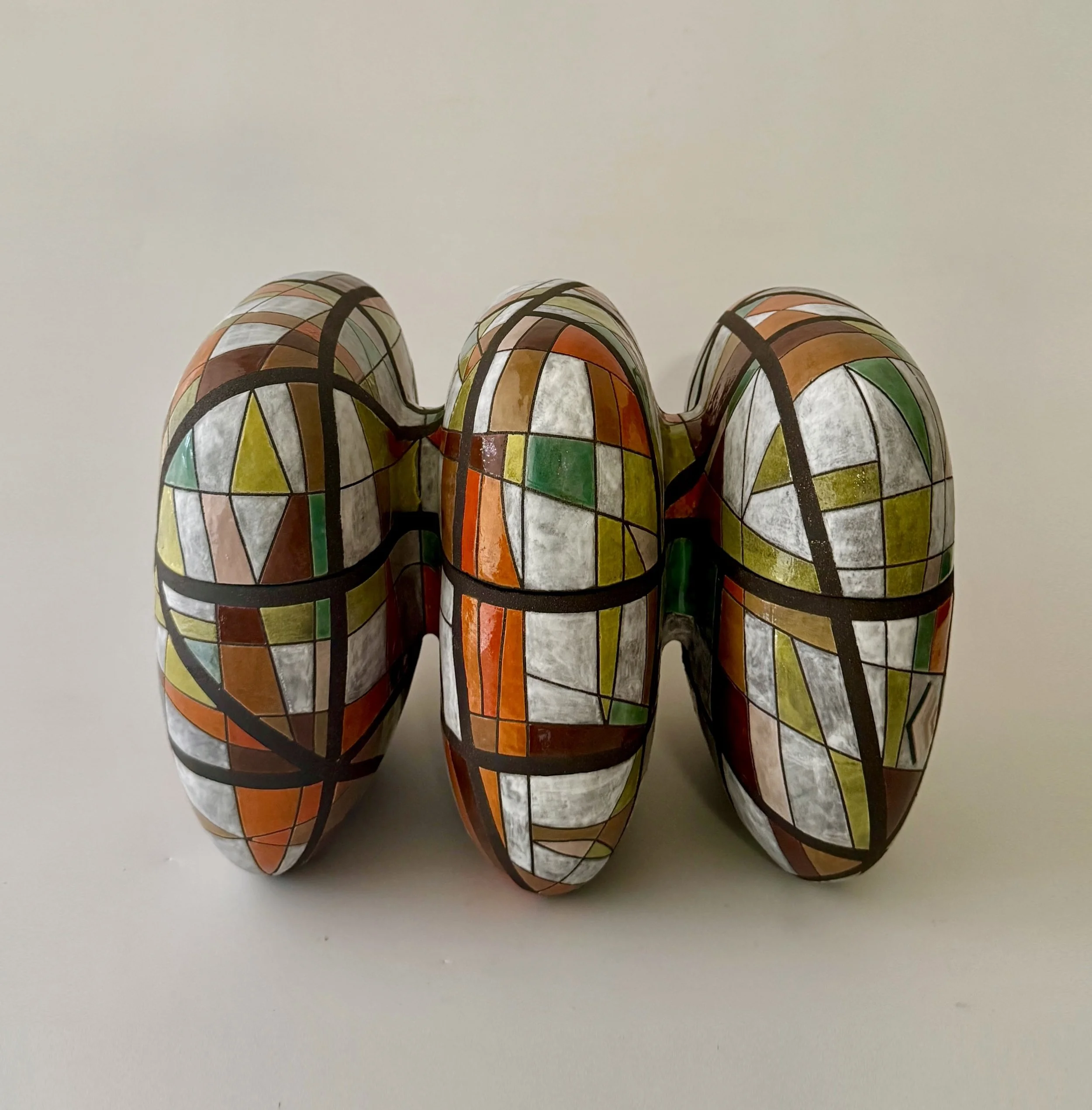
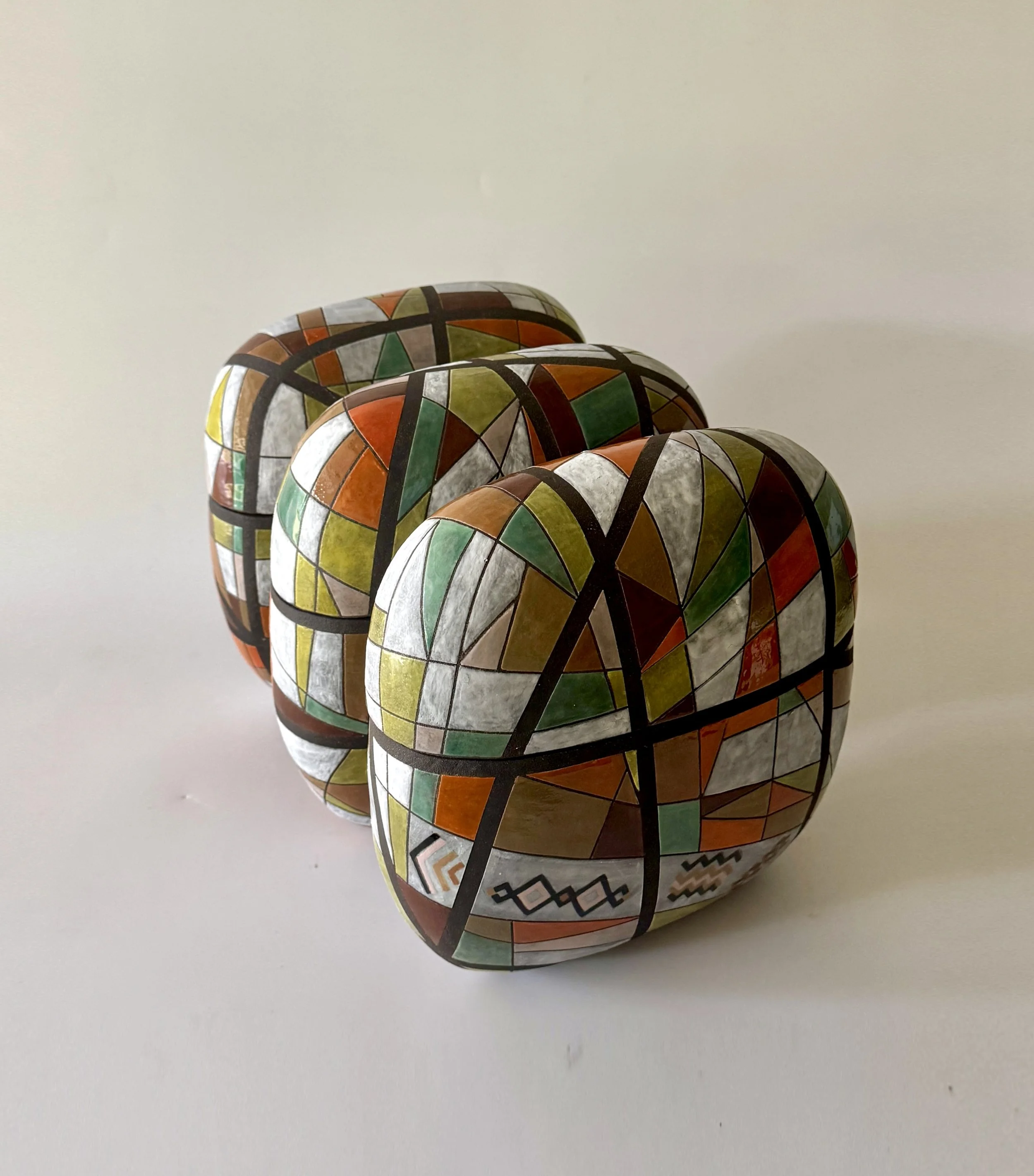
Year: 2026
Dimension: 36 x 30 x 25 cm
Material: Black clay, underglaze, glaze, oxidation fired at 1210°C
This work developed from Mitochondria: Ethiopia, Remembered in Color (2025). While the earlier work was made by applying colour over a white clay body, this time I chose black clay, allowing black to become the ground of the work. During firing, the dark clay subtly shows through the colours applied over it, naturally giving them greater depth. The result brings the image of Ethiopia that I have long held in my mind into a closer, more tangible presence.
The form has also developed into a lidded vessel. When opened, it reveals an interior left unglazed, exposing the black clay in its natural state, in contrast to the coloured exterior.
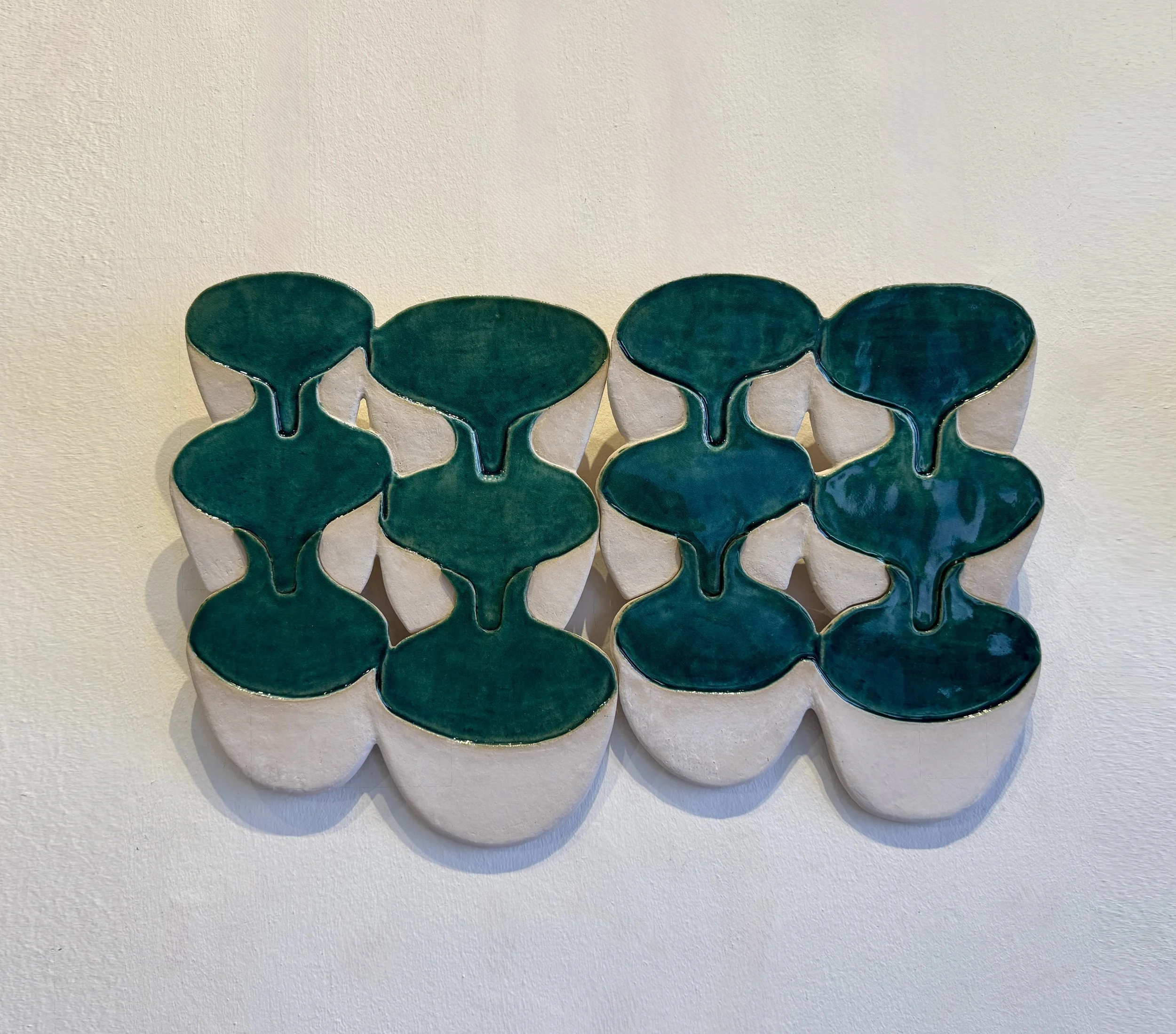
Mitochondria
: Flow and connection
Year: 2026
Dimension: 66 × 45 × 3 cm
Material: White Raku Clay, glaze, 1100°C
This work expands Mitochondria: Flowing from Top to Bottom (2024) into a wall installation. It is finished with a blue glaze that evokes the flow of water across a white, stone-like landscape, expressing the life energy passed down through generations that continues to flow within me. In this wall version, I experimented with the repetition of modular units to explore the possibility of expanding the form. The installation consists of twelve units, arranged as two identical sets of four and two units.
Mitochondria : Encounter
Year: 2026
Dimension: 31x38x5cm, 33x33.5x4.5cm
Material: Stoneware, glaze, gold luster, 1150°C
A wall-mounted ceramic installation depicting the moment when two mitochondria meet and begin to merge into one.
As an extension of my Window and Glow series, two mitochondria with square windows and golden shadows come together. One glows only from within, while the other casts a long golden shadow through its window.
In living cells, mitochondria constantly undergo fusion and fission, merging into one and dividing again into two. This work reflects those moments of connection, separation, and continuous transformation that sustain life.
Mitochondria
: Inside and Outside, 2026
Year: 2026
Dimension: 41 × 35 × 2.5 cm
Material: Red stonware, glaze, ceramic pencil, 1100°C
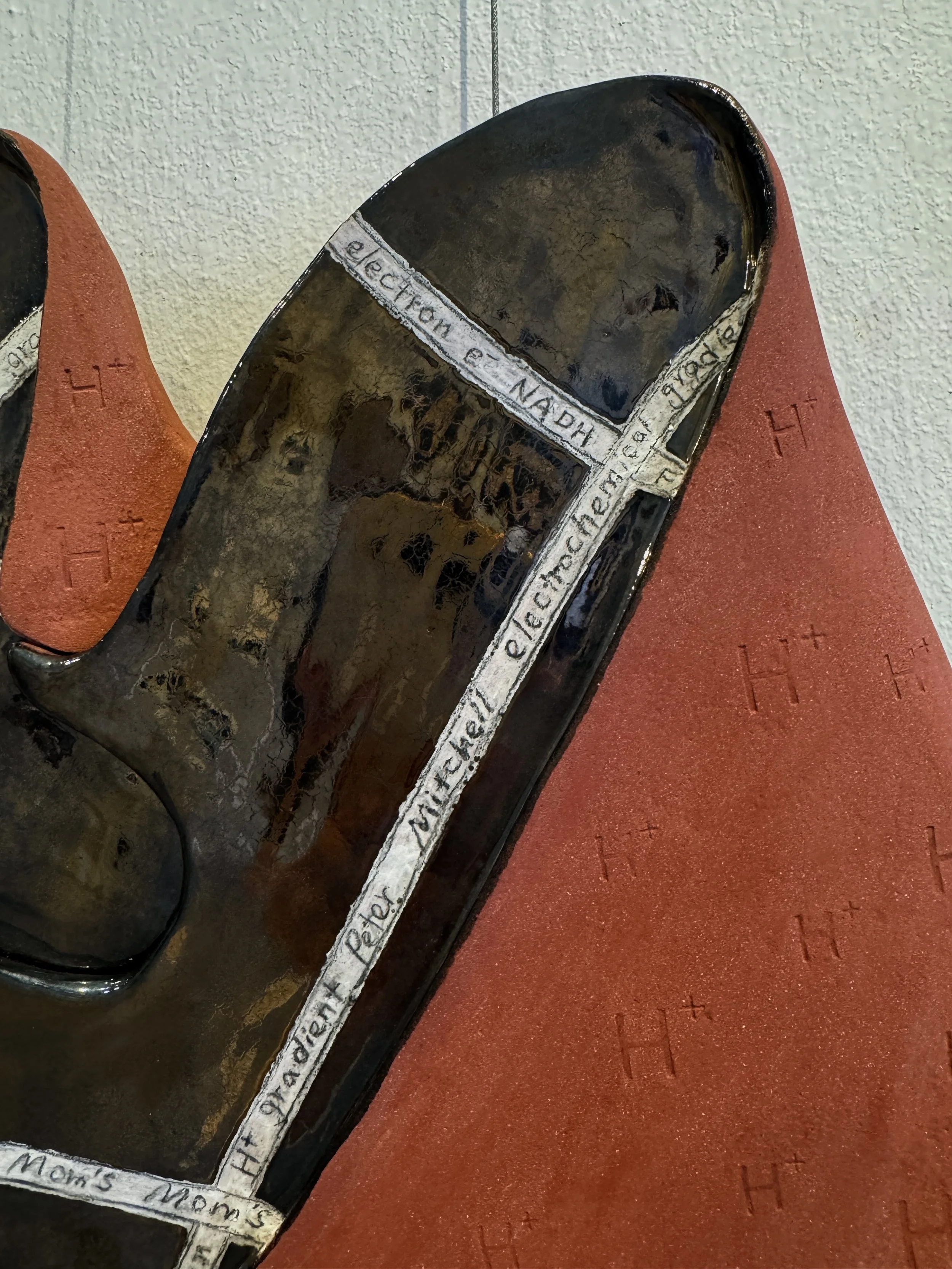
This work expands Mitochondria: Inside and Outside (2024) into a wall installation. The hydrogen ions concentrated outside the inner membrane are expressed as engraved marks on red clay, while the inner surface is finished with a bronze glaze to create a visual contrast. Each unit was fired separately and assembled into a wall installation.
Mitochondria
: Window and Glow
Year: 2026
Dimensions: 23.5 × 32 × 16 cm
Material: Stoneware clay, glaze, gold luster
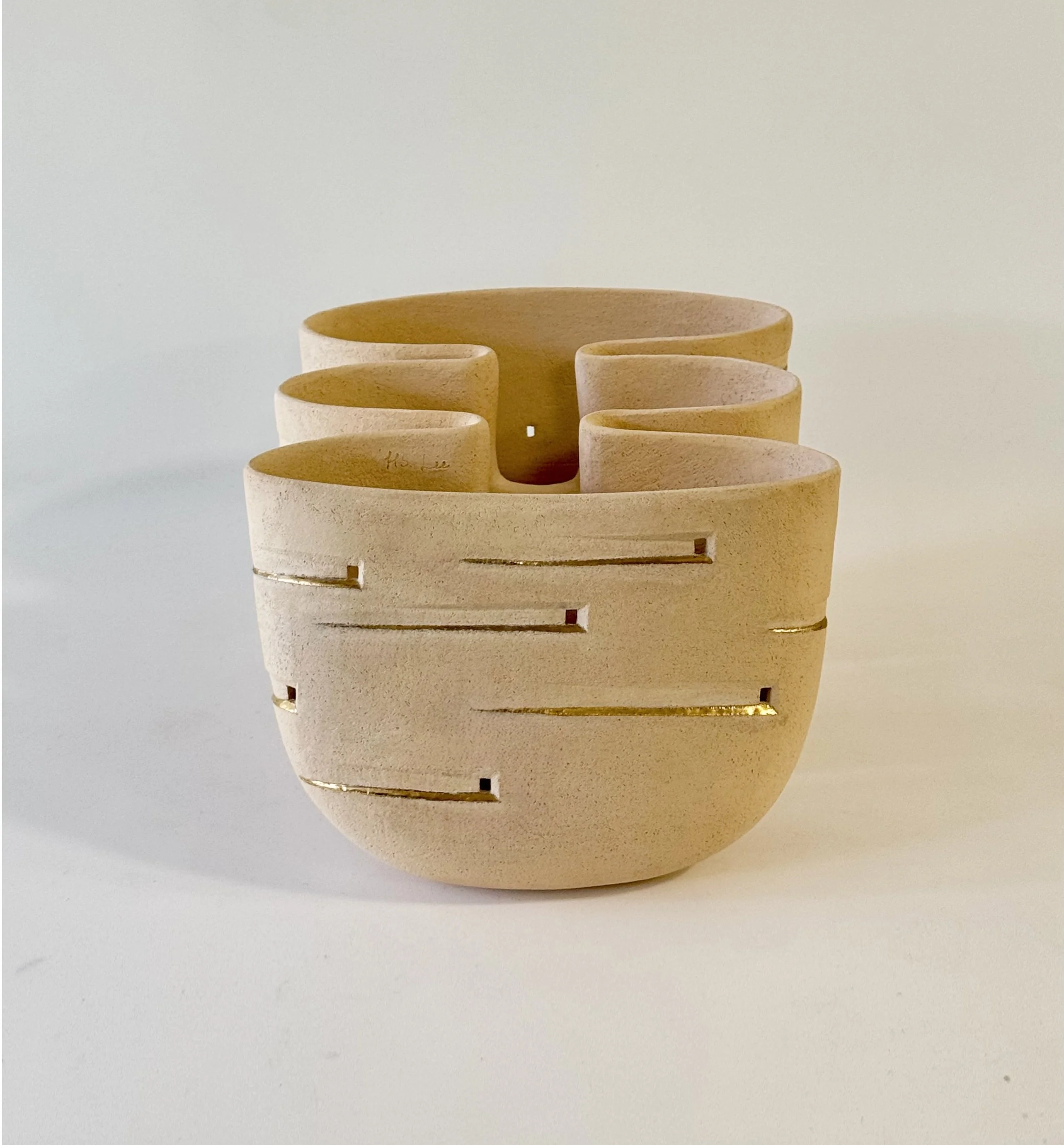
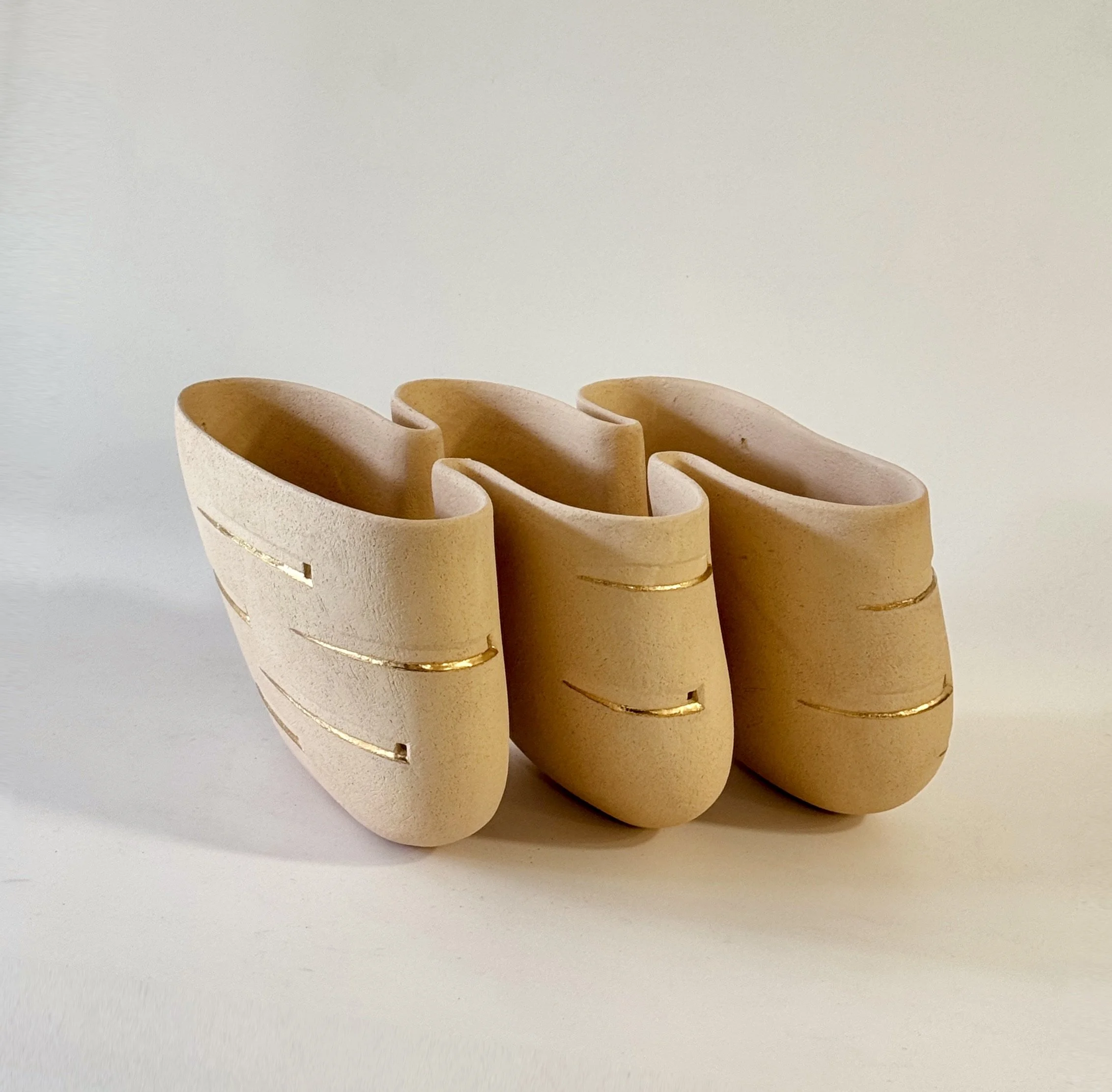
Light entering through the window casts layers of shadows. The light and shadows are sometimes sharp and short, and at other times soft and long. The membrane of the mitochondrion contains channels through which substances selectively pass. The window and golden shadows in this work are not intended to reproduce this scientific structure, but rather to project the scenes of light and shadow that I repeatedly encounter in everyday life. The light, and the shadows glowing in gold, seem to resemble the shadows of stars.
Mitochondria: Ethiopia, remembered in color
Year: 2025
Dimension: 29 x 30 x 22.5 cm
Material: Stoneware clay, underglaze, glaze, ceramic ink, oxidation fired at 1210°C
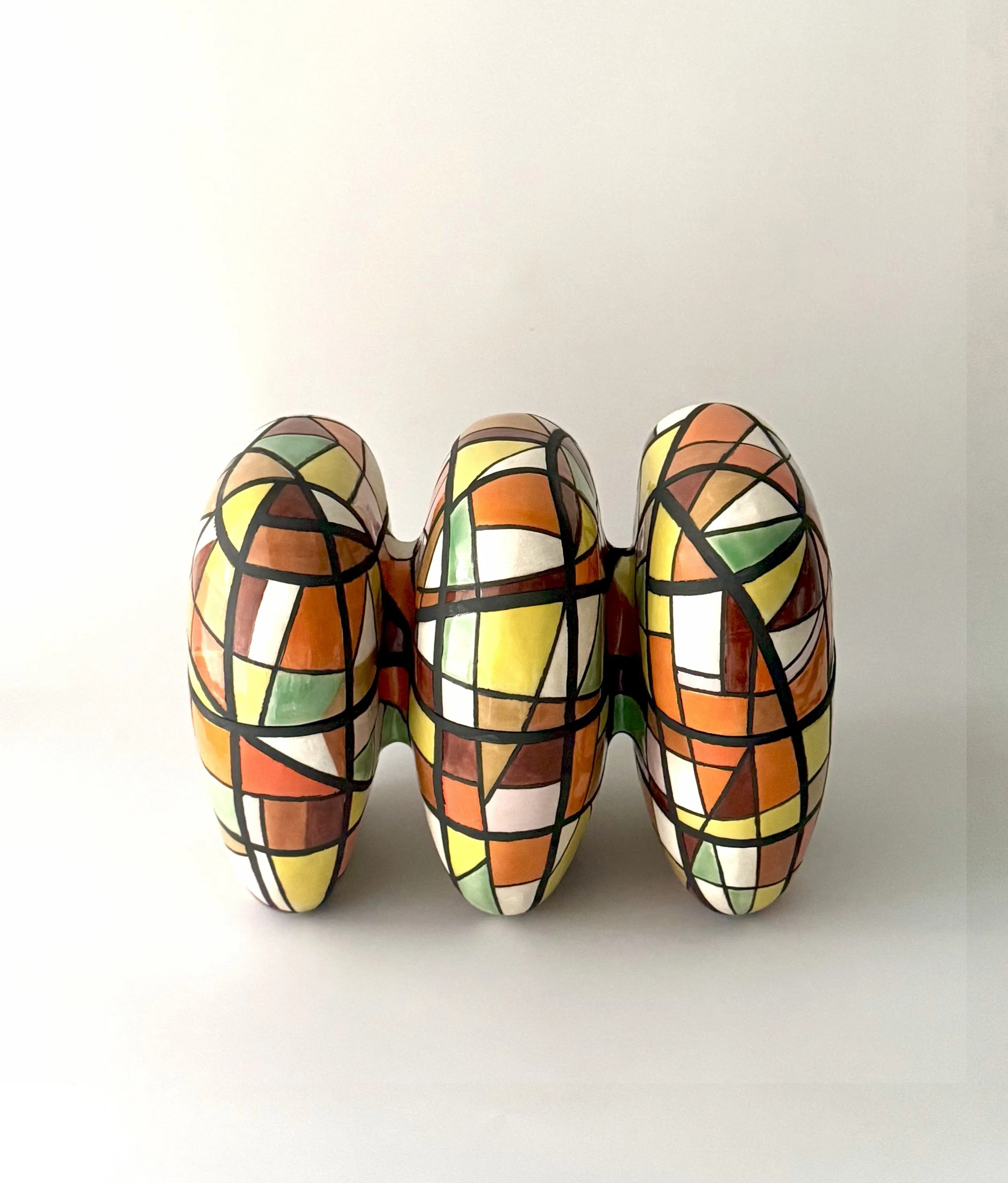
When speaking of human origins, one of the most frequently mentioned concepts is “Mitochondrial Eve.” By tracing the maternal line through mitochondrial DNA, we learn that the earliest woman of humankind originated in Ethiopia. Thus, we may say that the homeland of human mitochondria is Ethiopia itself.
Ethiopia also holds deep personal meaning for me. It is where my mother was expecting me — the place where my life began. Perhaps some elements of that land still remain within me. During my parents’ two-year stay in Ethiopia, they collected scarf and filigree (fine metalwork) necklace, which have since been passed down to me. Through these colors and objects, I remember Ethiopia. That memory is both my mother and the point of my own beginning.
This work grows from those memories, expressing through the colors of Ethiopia the life energy I inherited from my mother.
Mitochondria: Inside and Outside

Year: 2024
Dimensions: 28×32×17cm
Material: red clay, bronze glaze, ceramic stain and slip, ceramic pencil, oxidation fired at 1100°C

Mitochondria contain contrasting substances inside and outside their inner membrane. The inner space is filled with energy, while the outer space is abundant with hydrogen ions. This contrast is expressed in the work through both visual and tactile means.
The interior is coated with a metallic glaze that reflects light, creating a vivid sense of energy in motion. In contrast, the exterior reveals the natural brown texture of the clay, conveying warmth and stability. The presence of hydrogen ions in the outer space is represented by the engraved symbol H⁺.
Hydrogen ions are the starting point of energy generation — their concentration gradient drives energy production like a turbine in a hydroelectric power plant. In tribute to the scientist who discovered this principle, his name is also inscribed on the piece. It’s astonishing that mitochondria and the Sun harness hydrogen ions, the simplest and most abundant element in the universe, as the key to energy conversion.
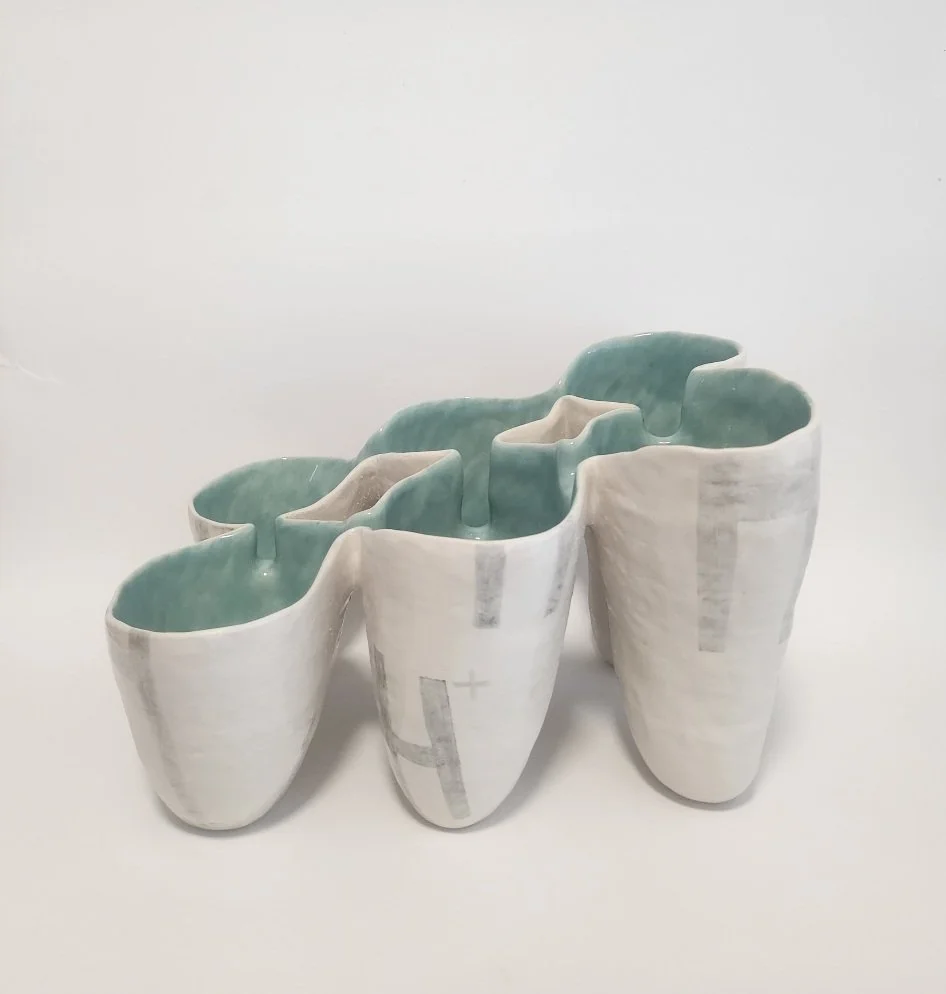
Mitochondria: Flowing from Top to Bottom
Mitochondria are passed from mother to child. While we inherit half of our genes from each parent, mitochondria are the only organelles inherited exclusively through the maternal line.
When I feel my strength running low, I often remind myself that the life energy passed down through generations continues to flow within me. What my mother received from her mother, and what she in turn received from hers, has been passed down to me.
This work reflects on that flow. I think about the desire to pass on what one has received to the next generation, hoping that they may live a better life. I imagined this movement as a flow from top to bottom and gave it form through clay.
Year: 2024
Dimensions: 22 × 29 × 17 cm
Material: Stoneware clay, underglaze, glaze, ceramic stain, oxidation fired at 1200°C
Mitochondria: Inner Charge

Year: 2025
Dimensions: 29.5 × 25 x 18.5 cm
Material: Stoneware clay with pigmented slip (sprayed), underglaze, glaze, oxidation fired at 1200°C
Though not visible from the outside, this work expresses the process of energy being accumulated and activated within. The row of small dots inside the reflective glazed interior symbolizes a precisely designed chain reaction—the electron transport chain. The H⁺ symbols painted on the surface represent hydrogen ions, the starting point of all life energy.

Mitochondria
Year: 2024
Dimensions: 25 × 30 × 19 cm
Material: Pigmented stoneware clay, underglaze, glaze, oxidation fired at 1200°C
Inspired by the warm pink and red hues of ancient cliff formations, this piece reflects the festival’s theme of primitivism—a return to origins and primitive experience (Matres Festival of Women’s Ceramics, Italy,2024). Inside, the forms of ATP synthase and the flow of the electron transport chain are simplified into circular motifs and dotted lines, then finished with a glossy glaze. The imagery draws inspiration from ancient cave paintings. The exterior is left unglazed to reveal a pink, rock-like texture, and the hydrogen ions that fill the intermembrane space are visualized as recessed impressions
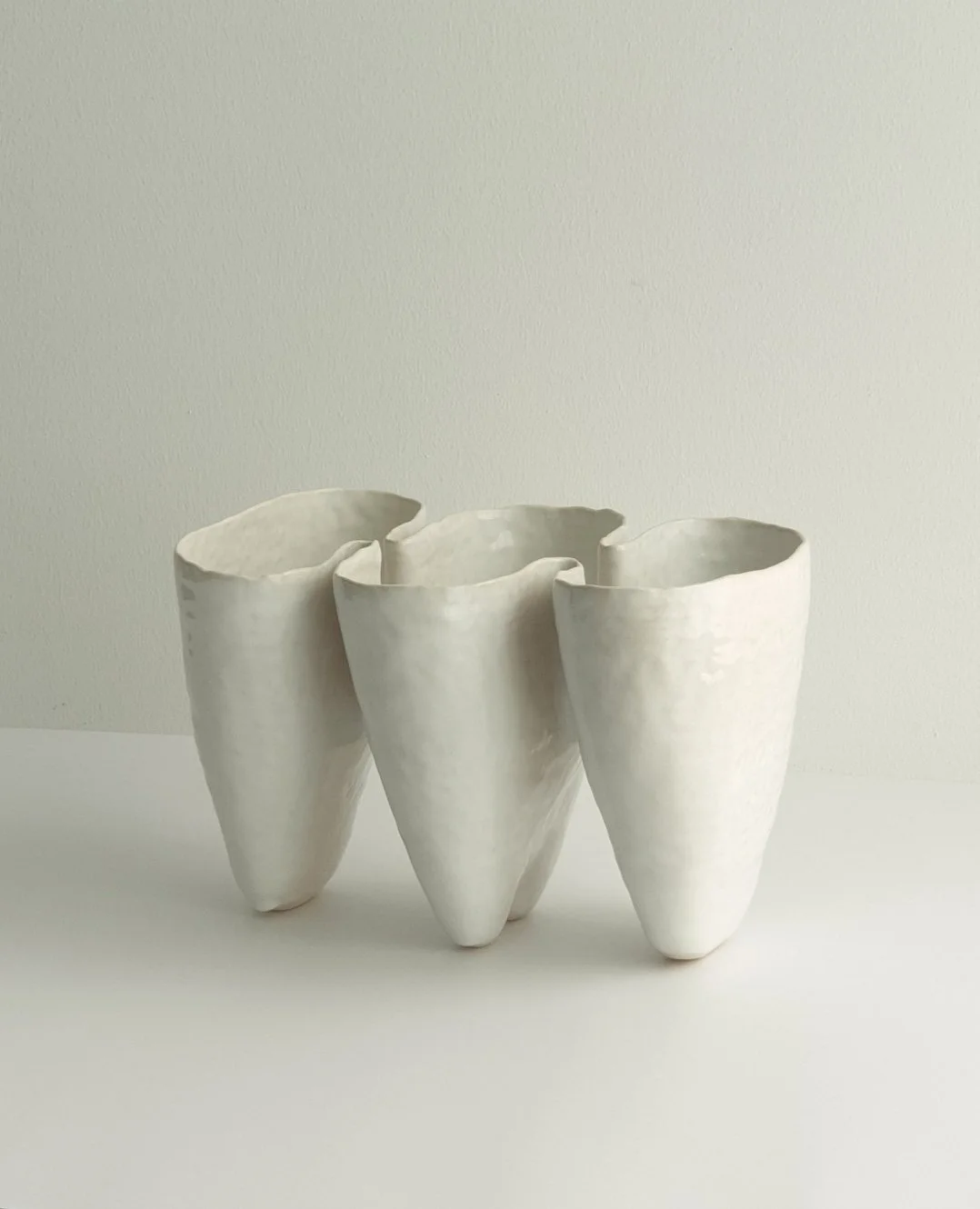
Vessel Containing Energy
Year: 2020
Dimensions: 32 × 20 × 24 cm
Material: Stoneware clay, handbuilt, white glaze, oxidation fired at 1200°C
This piece marks the beginning of the Mitochondria series. Created during a period of isolation at home in the pandemic, it emerged as I instinctively searched for a form that could sustain me at a time when I felt emotionally depleted. When the work was completed, I realized that the form I had been seeking was the mitochondrion. Its undulating structure—filled with the life-giving energy inherited from my mother— became something that supported me, and I came to call it a “vessel of energy.”
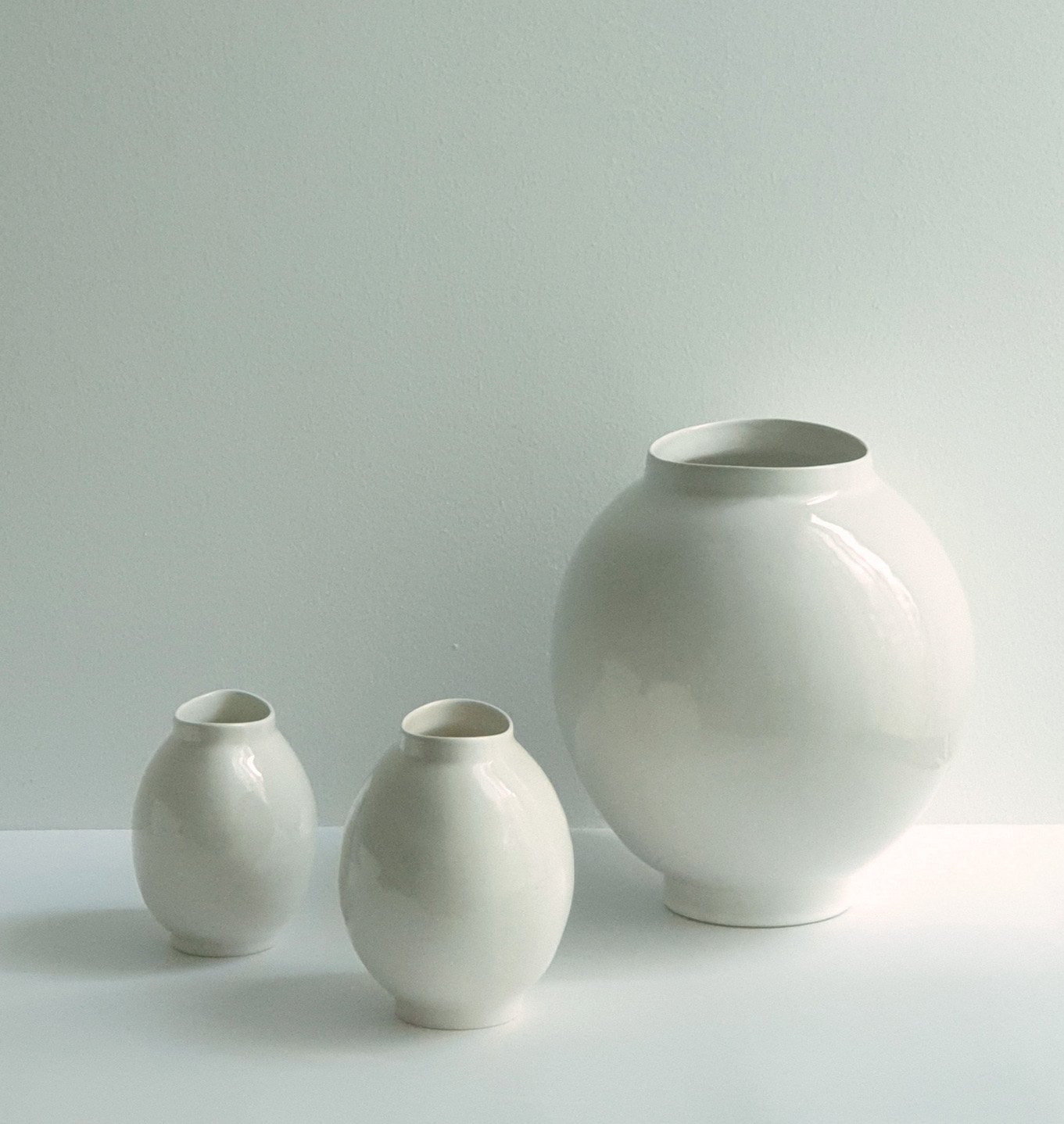
Ellipse Moon Jar
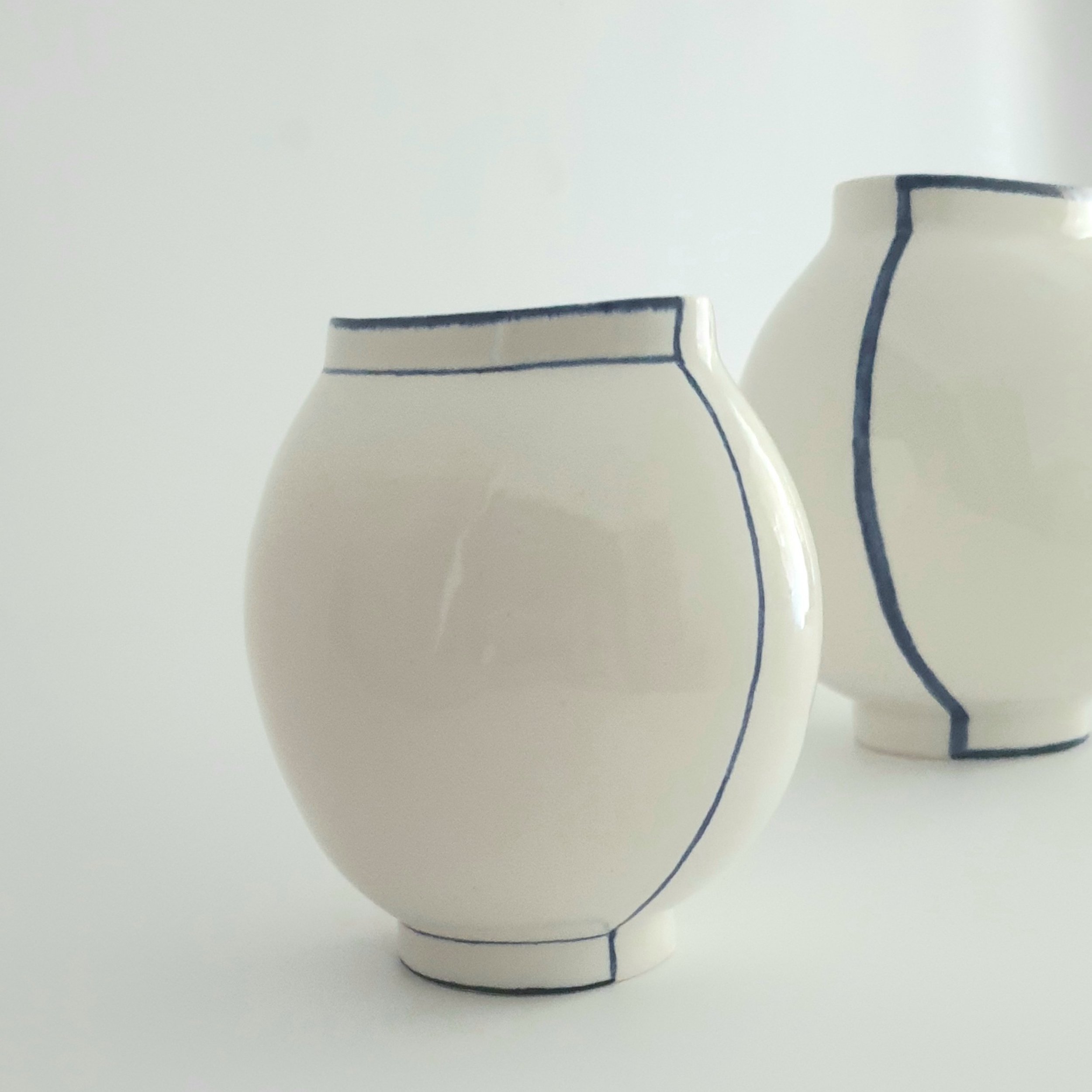
Ellipse Moon Jar reinterprets the round, traditional Korean moon jar through the form of an ellipse. After throwing a circular vessel on the wheel, I rehydrated the clay while it remained plastic, then carefully tapped and refined it by hand into an elliptical form. From the front, it appears like a traditional moon jar, but its proportions and silhouette change depending on the viewing angle.
Just as the Earth and other planets follow elliptical rather than perfectly circular orbits, I transformed each circular cross-section of the vessel into ellipses with slightly different proportions, gradually finding the overall balance of the form.
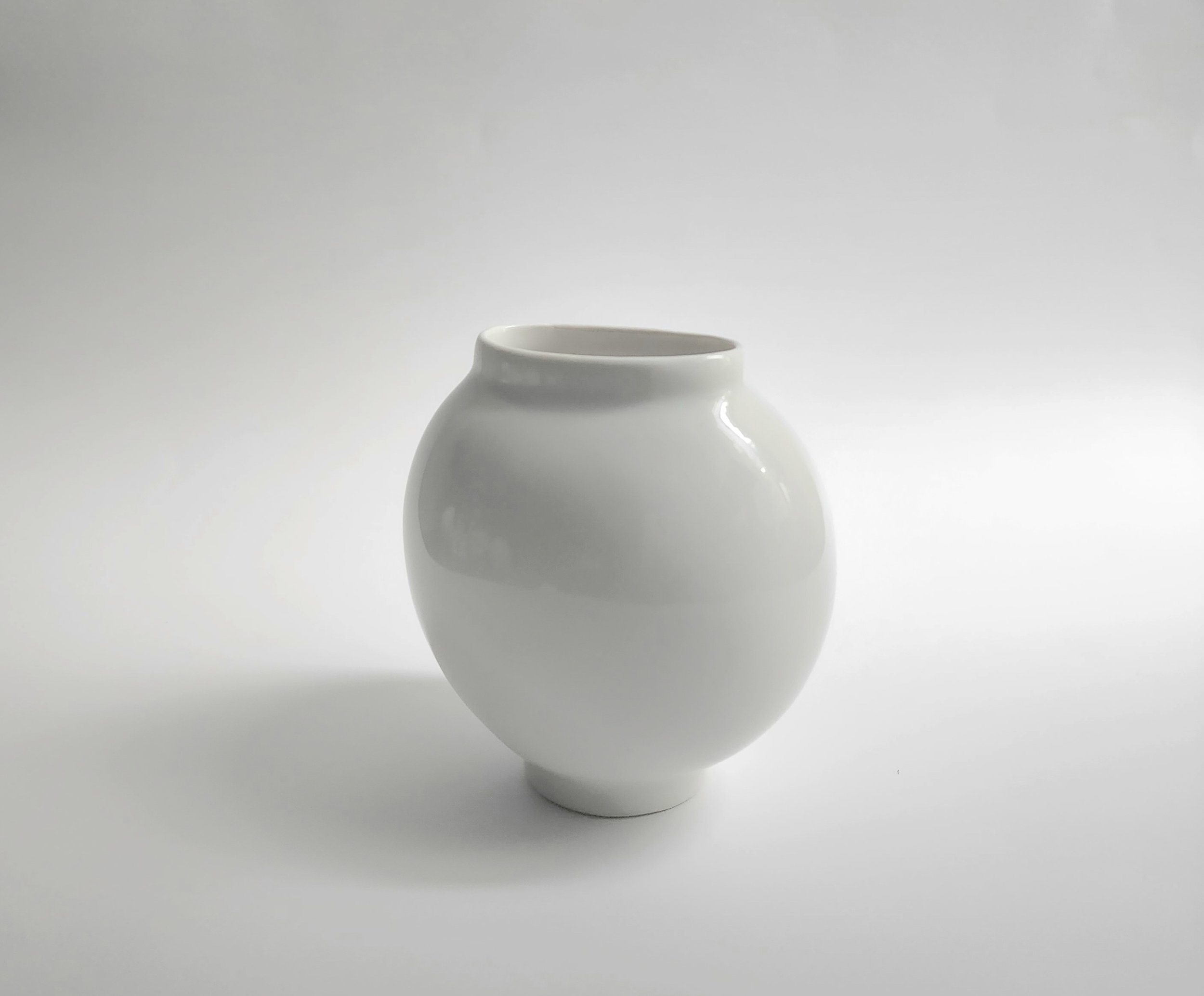
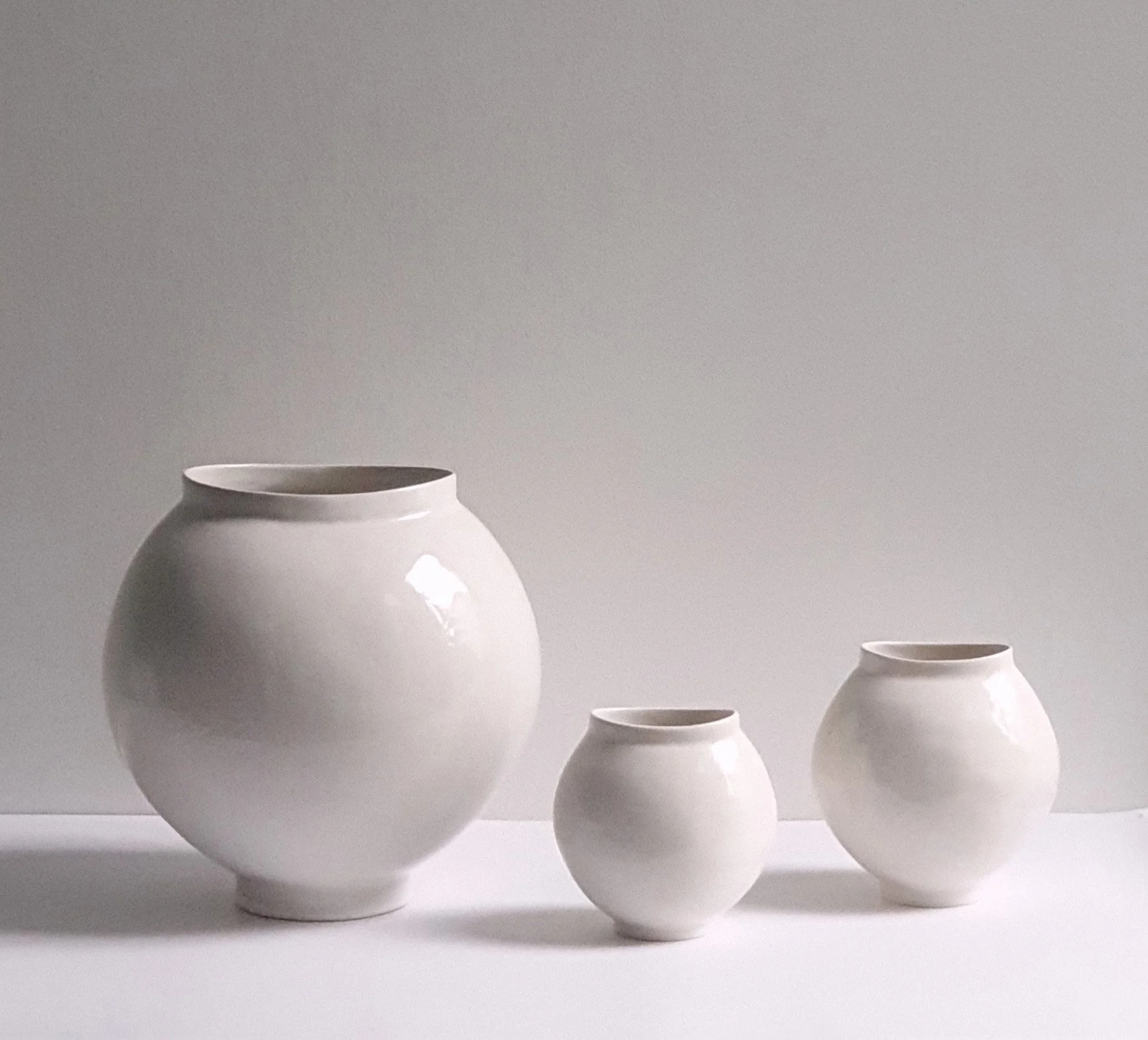
2021–2023
Stoneware, porcelain, glaze 1210°C